
News Archive
- Direct broadcast (DB) software packages for Metop-SG-A1 - September 2, 2026
An updated release of the DB packages for Level 0, MWS level 1 and METimage level 1 is available for download. This incorporates various changes made during the cal/val phase of the satellite. The NWP SAF scripts also support IASI-NG, and we will provide the package itself once formal approvals have been obtained, expected later this month. For details, please see the Metop-SG direct broadcast web page. - MWIPP version 1.3 has been released - August 10, 2026
MWIPP version 1.3 has been released. This update release includes support for AMSR-3 BUFR encoding (including a new test case), updates to the MWI/ICI processing and updates to the installation method to bring MWIPP into line with AAPP-SG and IRSPP. Further details at https://nwp-saf.eumetsat.int/site/software/mwipp/. - The NWP SAF Satellite Data Assimilation Training Course 2027 is open for registration - July 15, 2026
This course provides a comprehensive overview of the usage of meteorological satellite observations in operational numerical weather prediction (NWP). It includes a series of lectures and practical sessions covering a range of topics from fundamental theoretical concepts through to detailed practical implementations in modern state-of-the-art data assimilation systems. Applications for this course close on 25 Sept 2026. For further information, please visit https://events.ecmwf.int/event/577/ - IRSPP v1.4 has been released - June 16, 2026
Version 1.4 of the Infrared Sounder Pre-processor (IRSPP) has been released. This version is compatible with the in-orbit MTG-IRS data, as well as the final set of pre-launch test data. The update release includes a new test case (in-orbit data from November 2025), an option to perform spatial averaging, refinements to the output BUFR sequence, python tools for displaying the netCDF and BUFR data, and updates to the build scripts. Further details at https://nwp-saf.eumetsat.int/site/software/irspp/ - CATDS v4 has been released - June 5, 2026
Version 4 of the Cloud, Aerosol and Trace gas detection software (CATDS) has been released by the NWP-SAF. This package is used to identify channels in hyperspectral infrared spectra which are affected by atmospheric features that cannot be simulated accurately in a clear-sky assimilation framework for numerical weather prediction (NWP). This latest version includes a new neural-network emulator of the cloud and aerosol capability for IASI, which requires only observations as input (i.e. no model information). Also, cloud detection for CrIS is possibly in the absence of a long-wave infrared band (such as for S-NPP). Finally, the numerical precision of the variables can now easily be set by users, which can help with computational savings. For further information, please see: https://nwp-saf.eumetsat.int/site/software/cloud-and-aerosol-detection/ - AAPP-SG v1.0.0 has been released - June 2, 2026
A new package AAPP-SG has been released. It processes level 1 data from the MWS and IASI-NG instruments on the Metop-SG-A satellite series. Its functions include netCDF ingest, BUFR ingest, spatial filtering, spectral manipulations and BUFR output. It can be used with direct broadcast data or global/regional data. For more information, see the AAPP-SG web page. - NRT availability monitoring update - May 19, 2026
The NRT coverage and timeliness monitoring has been extended to now also include data from the MWR instrument on the Arctic Weather Satellite AWS and the lightning imager LI on MTG, based on the data reception monitoring at DWD. The new data have been included in the data status overviews: NRT availability status. Plots of data coverage as well as data delay information in the form of time series, PDF's of data timeliness and geographical plots of data timeliness are accessible via the following link: NRT availability. - Direct broadcast (DB) software packages for Metop-SG-A1 MWS and METimage - May 1, 2026
The NWP SAF has released the direct broadcast (DB) software packages for Metop-SG-A1 MWS and METimage. This allows users with a compatible DB reception system to process the raw data up to level 1B. The software packages have been procured from Industry by EUMETSAT, with the NWP SAF responsible for testing, release and user support. For details, please see the Metop-SG direct broadcast web page. - New NWP SAF Report Released: AWS Radiance Data Quality Assessment - April 29, 2026
NWP SAF has released a new technical report assessing the radiance data quality from the Arctic Weather Satellite (AWS) microwave radiometer. The study evaluates AWS observations from an NWP perspective, using independent monitoring at the Met Office and DWD with RTTOV-simulated equivalents. Results show stable radiance behaviour, well-characterised scan-angle biases, and instrument noise levels suitable for operational data assimilation. The new 325 GHz sub-millimetre channels demonstrate strong sensitivity to ice cloud scattering, offering promising capabilities for all-sky assimilation. Data availability and timeliness via EUMETCast are shown to be excellent, meeting global NWP requirements. An initial assimilation trial at the Met Office indicates a statistically significant positive forecast impact. Overall, the results confirm AWS radiances as high-quality, operationally valuable observations and a strong precursor to future EPS‑Sterna missions. The full report is available from the Publications page: https://nwp-saf.eumetsat.int/site/cdop4-reports-publications/#Technical_Reports - Report on MTG-I Level 2 data timeliness - April 28, 2026
As part of the NRT data availability monitoring activities, a report has been compiled looking at the availability and timeliness of L2 products from the MTG imager FCI that are of high interest to operational usage in NWP. These include the widely assimilated atmospheric motion vectors (AMVs) and all-sky radiances (ASR) derived from FCI observations as well as lightning flash products from the new lightning imager LI. The report is available under https://nwp-saf.eumetsat.int/site/cdop4-reports-publications/#Technical_Reports - NWP-SAF workshop on exploiting satellite cloud and precipitation observations for weather forecasting - April 10, 2026
Cloud and precipitation are some of the most important parameters in any forecast, yet they remain challenging to observe, model and predict. Our main source of observations is satellite measurements of the Earth's thermal radiation, reflected sunlight, and backscattered radar and lidar. Cloud and precipitation particles interact with this radiation through thermal absorption and scattering, which is strongly dependent on the shape, size and composition of individual cloud particles, and varies strongly with frequency. From this highly indirect information, we can only infer profiles of cloud and precipitation by combining these observations with models of atmospheric dynamics, cloud, precipitation and radiative transfer. But these models remain simplified, incomplete, and prone to systematic error. If we could reduce these errors, cloud and precipitation forecasts could be much improved. Therefore, the challenge in using cloud and precipitation observations is not just to use them to initialise forecasts, but to use them to improve the models themselves. Through a series of invited talks, this workshop will first review the state of the art in using cloud and precipitation observations, from the satellites to forecast and everything in between. Working group discussions will then try to inform future developments, considering questions such as: – Which cloud and precipitation observation types need more development, considering both future missions and existing data that is insufficient or under-exploited? – How can we combine information from active and passive observations, and from spectral regions from the microwave to the solar, to best effect? – How do we start inferring not just cloud and precipitation parameters, but equations and even models, from the observations? – What developments in physical modelling and data assimilation are needed to make better use of these observations? – How can machine learning and AI help? The workshop will take place on 9-12 November 2026 at ECMWF, Reading, UK, and will be held in-person only and attendance is by invitation. If you would like to be considered for an invitation, please see details on https://events.ecmwf.int/event/547/ - RadSim v4.1 has been released - March 26, 2026
RadSim v4.1 has been released. This has been updated to work with RTTOV v14.1. New features include: support for new RTTOV capabilities including MFASIS-NN aerosol simulations and new simulation options, option to specify a range of channels to simulate instead of an explicit channel list, and support for temporal interpolation between ECMWF GRIB fields at multiple analysis times (not only multiple forecast times). A full list of updates is here. - NRT availability monitoring update - March 24, 2026
The NRT coverage and timeliness monitoring has been extended to now also include data from the new MWS instrument on Metop SG A1 based on the data reception monitoring at DWD. The new data have been included in the status overviews: NRT availability status and plots for coverage as well as time series and PDF's of data timeliness and geographical plots of data timeliness are accessible via the following link: NRT availability - Update to the Web Based Satellite Sounding Training Application - February 11, 2026
Improvements to the WeSS4T web application: https://sounding.trainhub.eumetsat.int/, has been deployed on the Eumetsat Training Hub, hosted by the EWC. The update increases traffic load capability and improves overall user navigation. The application is an excellent tool for training in radiative transfer and for introducing the basic concept of data assimilation. Feedback regarding the use of this application is encouraged and appreciated. - RTTOV v14.1 has been released - February 10, 2026
RTTOV v14.1 has been released. Updates from v14.0 include: MFASIS-NN neural network fast solver for visible/near-IR scattering simulations improved to support additional VIS/NIR channels for cloudy simulations and now supports aerosol simulations with CAMS optical properties, new cloud overlap options have been implemented, new option to turn off cosmic microwave background radiation contribution (for use with obs that are processed to remove this), new option to exclude sun-glint from the solar sea reflectance model (for certain simulated imagery applications), optimisation of the SURFEM-Ocean microwave sea surface emissivity model for gfortran builds, optimisation of the DOM solar solver with Rayleigh multiple scattering, faster cloud simulations with maximum-random overlap due to elimination of redundant zero-width columns, and various other updates and improvements. See the RTTOV pages for more information. - Migration of “DBNet monitoring” email alerts to generic sender - January 9, 2026
The DBNet monitoring data outage and data consistency email alerts had previously been sent from a personal Met Office email account. However, as this is a service run on behalf of EUMETSAT's NWP SAF, it seems appropriate that a more generic email address is used as sender. Therefore, as of the 9th January, these email alerts are sent from the email address dbnet-monitoring@metoffice.gov.uk, with the Display Name "NWPSAF DBNet monitoring". - Extension of the Data Reception Status Overview Page - December 3, 2025
The data reception status overview page provides near real time information in the form of traffic light overviews for current data numbers and data timeliness for the various satellite instrument data sets. This page has now been extended to also show current timeliness compared to fixed timeliness thresholds in addition to the overviews comparing current data numbers and timeliness to their respective typical values over previous months. Results are based on an auto-alert system evaluating data reception statistics at both the German Weather Service and the UK Met Office. Please visit the Overview of data availability and timeliness status page for viewing the plots and further information. - The NWP-SAF 1D-Var v2.1 has been released. - November 28, 2025
This release adds support for RTTOV v14. Support for RTTOV v13 and v12 is maintained. Support for RTTOV v11 has been removed. The new version is backwards compatible with v2.0 with the following exceptions: changes to the Sample Background data mean the sample data for each RTTOV version has changed, changed limit of BT difference in O-B check so more tests now pass, changes to SSMIS setup to account for new additions in RTTOV-14. For additional information, please refer to the the software pages https://nwp-saf.eumetsat.int/site/software/1d-var/. - NRT availability monitoring update - October 3, 2025
NRT availability monitoring update The following new data sets have been added to the near-real time data availability monitoring with the plots being available since 12 Aug 2025: Scatterometer winds from HY-2B, HY-2C and OceanSat-3; Altimeter winds from CFOSAT, Sentinel-6a; AMVs from VIIRS of NOAA-20, NOAA-21 as well as LeoGeo AMVs from VIIRS and GEOs; AMVs and ASR from GOES-19 and MET-12. As for all other instruments, data coverage and timeliness is evaluated four times daily in 6 hour time windows around 00 UTC, 06 UTC, 12 UTC, 18 UTC. The new data have been included in the status overviews: NRT availability status And plots for coverage as well as time series and PDF's of data timeliness and geographical plots of data timeliness are available under the following link: NRT availability - NWP SAF Satellite Data Assimilation Training Course 2026 is open for registration - September 10, 2025
This course provides a comprehensive overview of the usage of meteorological satellite observations in operational numerical weather prediction (NWP). It includes a series of lectures and practical sessions covering a range of topics – from fundamental theoretical concepts through to detailed practical implementations in modern state-of-the-art data assimilation systems. Applications for this course close on 30 November 2025 For further information, please visit https://events.ecmwf.int/event/499/ - Update to the monthly AMV monitoring - July 21, 2025
The monthly AMV monitoring web pages, https://nwp-saf.eumetsat.int/site/monitoring/winds-quality-evaluation/amv/amv-monthly-monitoring/, have been updated to include O-B plots against the DWD global model background. This enables further comparison of AMV departures with the existing plots from the Met Office and ECMWF and will help separate error contributions between the observations and the models. The DWD statistics are available for the map, zonal, and density (2D histograms) plots. - FY-3E HIRAS and FY-4B GIIRS Monitoring Update - July 7, 2025
The monitoring of the Chinese hyperspectral infrared sounders HIRAS on board the LEO platform FY-3E and GIIRS on board the GEO platform FY-4B are now available from the NWP SAF monitoring page: https://nwp-saf.eumetsat.int/site/monitoring/nrt-monitoring/ - AAPP update 8.15 has been released - July 1, 2025
This release includes a bug fix for Arctic Weather Satellite (AWS) processing to l1c and the addition of a new python script aapp_BUFR_quicklook.py to plot AWS BUFR data (as well as other microwave sounder BUFR data). Additionally amsua_clparams.dat has been updated, new satellites added into 'get_tle' script, and use of the gcc14 gfortran compiler is now supported. For details, see the Release History. - Discontinuation of DMSP SSMIS - June 27, 2025
Dear NWP SAF users, Please note, due to the service changes, the U.S. Department of Defense (DOD) will discontinue the ingest, processing, and distribution of all DOD DMSP and Navy Fleet Numerical Meteorology and Oceanography Center (FNMOC) data no later than Monday, 30 June 2025. NOAA Environmental Satellite Processing Center (ESPC) interfaces will not receive DMSP data and all data products will be suspended. Users should expert all FINE, SMOOTH, and HOUSEKEEPING data from Operational Linescan System (OLS), Special Sensor Microwave Imager Sounder (SSMIS), and all Near-Earth Space Weather instruments will be terminated. This service change and termination will be permanent. As a consequence, SMMIS monitoring will no longer be available from the NWP SAF website and partners. - New NWP model dataset of 100,000 atmospheric profiles from CAMS - June 5, 2025
A new extra-large set of diverse atmospheric profiles has recently been compiled by the NWP SAF and is now available to the scientific community for the first time in nearly 10 years. Comprised of a year of ECMWF Copernicus Atmospheric Monitoring Service (CAMS) forecast data on 137 levels, the profiles represent one of the most up-to-date estimates of the vertical structure of several significant meteorological variables, atmospheric gases, and aerosols. Each subset of 5000 thermodynamically consistent profiles is meticulously selected to form a microcosm of the full model, optimised for 20 important atmospheric variables. The dataset can be used to train or validate a variety of model applications. RadSim v4 – to be released soon – will be able to ingest this new dataset, supporting clear-sky, aerosol, and hydrometeor RTTOV simulations with these new profiles. Read the whole article here. - 11th Analysis Report of the NWP SAF AMV monitoring - April 1, 2025
The 11th Analysis Report (AR11) of the NWP SAF AMV monitoring has been released and is available from the Analysis Reports section of the AMV monitoring webpages. The analysis reports identify features from the monitoring statistics and document how these evolve over time. The status of existing features identified in the monitoring has been updated to reflect changes in the past two years. Several new data sets have been added to the monitoring since AR10. The assessment looks at NOAA-21 VIIRS AMVs, and the inclusion of DWD model data. Alongside these new data sets there have been changes in derivation methods including the rollout of NOAA’s enterprise algorithms. The impact of this change on the monitoring has been evaluated. Further investigation for some existing and new features has expanded our understanding of the cause of the difference between the AMVs and the model. These include the MSG positive bias over N. Africa, the positive speed bias in tropics for MSG and FY-2, and differences between Met Office, ECMWF and DWD statistics for Himawari. - Meteosat 12 (MTG-I1) Monitoring - March 27, 2025
The monitoring pages have been enhanced to include Meteosat 12 (MTG-I1) near real-time (NRT) radiance quality monitoring (Hovmoeller, time-averaged geographical mean, and time series plots) and Atmospheric Motion Vector (AMV) monthly monitoring (density, map, zonal, and vector plots). For more information, please visit: Meteosat-12 FCI plots AMV Monthly Monitoring - RTTOV v14.0 released - February 10, 2025
RTTOV v14.0 has been released. This is a major update to the software with numerous improvements and new features, including: changes to the representation of the atmospheric profile to improve consistency with NWP model fields; implementation of the microwave scattering science within RTTOV (the separate "RTTOV-SCATT" model no longer exists); improvements to the accuracy and speed of the MFASIS-NN fast visible cloud solver and support for additional channels; a new heterogeneous surface capability allowing multiple surface types to be associated with each profile; and support for the CAMEL v3 land surface emissivity atlases. The full list of updates is available here. - AAPP update 8.14 has been released - January 20, 2025
This release includes an additional module for processing level 1B data from the Arctic Weather Satellite (AWS1). It also adds support for MWHS-2 and MWTS-3 on FY-3F (hdf5 ingest and BUFR encoding), as well updating amsua_clparams.dat. For details, see the Release History. - Summary and recommendation from the NWP SAF Workshop on Satellite Observations of the Earth System Interfaces - January 16, 2025
The NWP SAF Workshop on Satellite Observations of the Earth System Interfaces was held from 19 to 22 November 2024 at ECMWF. The workshop focused on advancing the exploitation of satellite data in NWP, emphasizing the importance of interface observations that are sensitive to multiple components like the atmosphere, land, sea ice, snow, and the ocean. Key recommendations include enhancing the use of existing and new satellite observations, leveraging machine learning for complex surfaces, and promoting coupled data assimilation for better exploitation of interface observations. The workshop highlighted the need for collaboration among scientific communities and space agencies to address challenges and improve the use of satellite data in NWP. To read the full summary, please go to our Training and Outreach page. - New Monitoring Page for NRT Availability and Timeliness Status - November 26, 2024
A new monitoring page is now available to provide near real time updates on the reception status of the main satellite data sources used for NWP applications. This page aims to enhance transparency and accessibility for users, ensuring they have the latest information readily available. Please visit the Overview of data availability and timeliness status page for further information. - IRSPP v1.3 has been released - October 31, 2024
The main changes in IRSPP v1.3 are (i) to support the IRS test data released by EUMETSAT in July 2024, (ii) to remove obsolete HT-FRTC functionality (which is no longer supported in RTTOV) and substitute equivalent functionality for PC-RTTOV, (iii) to update the output BUFR sequence following user feedback. Further details at https://nwp-saf.eumetsat.int/site/software/irspp/ - NWP SAF Workshop on Satellite Observations of the Earth System Interfaces - July 16, 2024
Interface observations refer to observations that are sensitive to multiple Earth system components, including atmosphere, land, sea ice, snow, and the ocean. They are key for Numerical Weather Prediction (NWP) and reanalysis. In a coupled data assimilation framework, used in Earth system approaches, satellite-sensed interface observations have the unique potential to simultaneously constrain the various Earth system components, providing consistent initial and boundary conditions to Earth system prediction models. Topics: - provide an overview of the various interface observations which are available to the NWP community as well as of the forward models which are being developed or are already in use to exploit this type of observations, - assess the state-of-the-art on the use of interface observations both in retrievals and in coupled data assimilation systems and - understand the direction in which the scientific community is taking this important and complex problem. The workshop will take place at ECMWF, Reading, UK, on 19-22 November 2024. This is an in-person event and is by invitation only (if you have not been invited and wish to attend the event, please contact events@ecmwf.int). For further details, please check https://events.ecmwf.int/event/420/ - NRT availability monitoring update – Dec 12, 2023 - December 18, 2023
The near-real-time data availability monitoring has been updated to provide coverage and timeliness plots based on DWD reception for the ATMS and CrIS instruments on NOAA-21. Please visit the NRT availability monitoring web pages to access the plots.
- NWP SAF Satellite Data Assimilation Training Course - December 1, 2023
The next NWP SAF satellite data assimilation training course will take place at ECMWF, Reading, on 11-15 March 2024. The course provides a complete overview of the usage of meteorological satellite observations in operational numerical weather prediction. It includes a series of lectures and practical sessions covering a range of topics – from fundamental theoretical concepts through to detailed practical implementations in modern state-of-the-art data assimilation systems. Registration for this course closes on Monday, 18 December 2023. More information on https://events.ecmwf.int/event/375/ - NWP SAF SSMIS PP package retirement - June 15, 2023
Dear NWP SAF user,The SSMIS Pre-processing Package (SSMIS PP) currently supplied and maintained by the NWP SAF processes data from the SSMIS instruments on board the US Defence Meteorological Satellite Program (DMSP). There are two aspects to the processing in SSMIS PP:
- Handling the “LAS”, “UAS”, “IMG” and “ENV” BUFR files and detecting instrument anomalies, for DMSP F16 only. This aspect is now obsolete as the Unified Pre-processor (UPP – maintained by the US Naval Research Laboratory) routinely performs this step for all functioning SSMIS instruments.
- Spatial averaging capability, applicable to UPP BUFR files, in order to reduce instrument noise.
The second point is now fully supported by the Microwave Imager Pre-processor (MWIPP) which supersedes that of the SSMIS PP. As such the NWP SAF SSMIS PP package will be retired, and support will no longer be offered upon the release of MWIPP v2 in April 2025.
For all additional information, please refer to SSMIS PP web pages https://nwp-saf.eumetsat.int/site/software/ssmis-pp/ and MWIPP web pages https://nwp-saf.eumetsat.int/site/software/mwipp/ or contact the team via the NWP SAF Helpdesk https://nwp-saf.eumetsat.int/site/help-desk/.
Kind regards,
The NWP SAF team.
- NRT availability monitoring update - May 25, 2023
The near-real-time data availability monitoring has been updated to provide coverage and timeliness plots based on DWD reception for the geostationary radiances and AMVs from Himawari-9, GOES-18, MTEOSAT-10 as well as microwave radiances from MWTS-3 and MWHS-2 on the early morning orbit satellite FY-3E. Please visit the NRT availability monitoring web pages to access the plots https://nwp-saf.eumetsat.int/site/monitoring/nrt-availability/.
- 10th Analysis Report of the NWP SAF AMV Monitoring - May 24, 2023
The 10th Analysis Report of the NWP SAF AMV monitoring has been released and is available from the Analysis Reports section of the AMV monitoring webpages (https://nwp-saf.eumetsat.int/site/monitoring/winds-quality-evaluation/amv/amv-analysis-reports/). The analysis reports identify features from the monitoring statistics and document how these evolve over time. Where possible attempts are made to diagnose the cause of the difference between the AMVs and the model. This edition includes the use of the NWC SAF software package to look at two AMV case studies in the Tropical East African region, namely mesoscale convective systems and winds in the boundary layer.
[caption id="attachment_48634" align="alignnone" width="300"]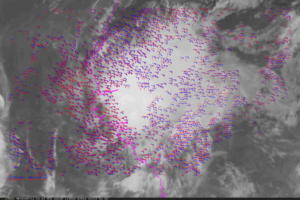 Mesoscale convective systems 11:45 UTC on 24/08/2022. Red vectors are NWC SAF AMVs and blue vectors model guess.[/caption]
 - NWP SAF Satellite Data Assimilation Training Course - May 10, 2023
The next NWP SAF satellite data assimilation training course will take place at ECMWF, Reading, on 15-19 May 2023. The course provides a complete overview of the usage of meteorological satellite observations in operational numerical weather prediction (NWP). It includes a series of lectures and practical sessions covering a range of topics – from fundamental theoretical concepts through to detailed practical implementations in modern state-of-the-art data assimilation systems. Registration for this course is closed but lecture notes and course materials are available online. More information on https://events.ecmwf.int/event/334/ - Updates to DBNet station status page - March 16, 2022
The DBNet “Station Status” webpage now highlights any station data feeds with poor consistency with global data (as well as displaying reception status). Please refresh the cache if this page isn't updating as expected (by pressing CTRL + F5 on a Windows browser). Additional data consistency email alerts are also now being sent to regional centre coordinators and station operators to warn of any new consistency failures. - New DBNet station status page - January 17, 2022
A new “Station Status” webpage displaying the reception status of all DBNet stations is now available from the > Monitoring > DBNet menu. Additionally data outage emails will be sent to regional centre coordinators and station operators to warn of missing DBNet data streams from 18/02. - MWRI DBNet monitoring page added - June 2, 2021
DBNet monitoring is now being performed for FY-3D MWRI, see monitoring page. In addition, an update has been made to the monitoring software. In future, this should eliminate the occasional cases seen of incorrect DBNet-global scanline matching, which has resulted in plots displaying a few scanlines with very large navigational differences (as well as sections of the overpass with large BTDs). - EUMETSAT NWP SAF mesoscale wind data assimilation workshop 2nd announcement - May 29, 2018
Tallinn, Estonia, Tuesday 18 September, 10:00-13:30, Tallink City Hotel Second and last announcement The place and time of the EUMETSAT NWP SAF mesoscale wind data assimilation workshop are now set. Those who have not registered yet for this workshop are asked to do so before June 30th by sending an email to scat@knmi.nl. No further announcement will be send to all. Further communications about the workshop agenda will be send to the registered participants only. Moreover, your registration is needed to organize the meeting facilities. A meeting agenda will be provided in July. More details available on the training pages. - RTTOV v12.2 released - April 6, 2018
RTTOV v12.2 has been released. Updates from the previous version, v12.1, include the option to run the MFASIS fast visible cloud parameterisation, new visible/IR cloud liquid water optical properties expressed in terms of particle size, RTTOV-SCATT updates (calculations in terms of radiance instead of brightness temperature, optional output data enabling dynamic all-sky emissivity retrievals, new optical properties for cloud liquid water and non-spherical particles), a new solar sea BRDF option, new MW cloud liquid water permittivity parameterisations, new PC-RTTOV coefficients enabling all trace gases and aerosols, and a much improved implementation of the HTFRTC PC-based model in RTTOV. See the RTTOV pages for more information. - Release of new NWP SAF ERA-5 satellite monitoring - March 7, 2018
Satellite monitoring time-series using ERA-5 as the reference atmospheric state are now available on the ECMWF monitoring site, and linked from the Monitoring overview page. Atmospheric states produced by re-analysis projects are generated using a fixed state-of-the-art NWP system applied to historical observations. As such they provide a much more suitable reference against which we can assess the quality of a satellite over its lifetime. To support users involved in climate applications, long timeseries quality statistics for satellites monitored against the ERA-5 reference have been included as an additional option to the existing operational monitoring web pages. ERA-5 replaces ERA-Interim as the primary ECMWF reanalysis product, but both will remain openly available on the ECMWF website. An expanded list of satellite sensors (compared to ERA-Interim) is provided in the new ERA-5 products. Further information can be found in the release note. - DBNet monitoring pages - February 8, 2018
The DBNet monitoring pages have been upgraded. These pages monitor the consistency between DBNet and global data for each of the instruments that are part of DBNet. The main changes are: (i) monitoring for AMSU, MHS and HIRS is now done at level 1c, for each instrument separately, whereas previously they were monitored on the HIRS grid only; (ii) the top page for each instrument includes a table of overpass statistics, with facility for selecting specific satellites or stations, or for highlighting overpasses that triggered warnings in the monitoring system. In the new system it is much easier to identify issues that need addressing. The daily plots of passes from each station (previously on the top page) are still accessible via links from each instrument monitoring page. - NRT data availability monitoring plots - September 28, 2017
NRT data availability monitoring plots are now available. This new component of the NWP SAF data monitoring activities focuses on the availability of near-real time data. Additionally to the classic data coverage plots, it also provides time series of the number of received data and data timeliness information which evaluates the delay between observation time and data bank entry time. The information provided will evolve further in the near future through the addition of more plot types and results of further contributing centres to allow cross-comparisons. Please visit the NRT availability monitoring webpages for further information - Radiance Simulator v2 released - May 10, 2017
Radiance Simulator v2 has been released. The code has a number of enhancements over the previous version, including; support for RTTOV v12, input profile batching (to enable simulation of very large datasets), support for emissivity atlases, land-sea-mask interpolation and other improvements and bugfixes. Please see the Radiance Simulator webpages for further information. - PenWP v2.1 released - February 28, 2017
PenWP v2.1 has been released in February 2017. This version of the Ku-band pencil beam scatterometer wind data processor can process OSCAT data from ScatSat-1. In the Ambiguity Removal step, empirical background error correlations (NBECs) can be used which yield improvements in the retrieved wind fields. Version 2.1 is also the version to be used for Oceansat-2 reprocessing in the OSI SAF, backscatter calibration tables have been modified accordingly. - NWPSAF 1D-Var v1.1 released - February 27, 2017This is to announce the release of version 1.1 of the NWPSAF 1D-Var.The main new capabilities of this version are:
- Support for RTTOV v12 , enabling the most up-to-date RT capabilities (RTTOV 11.3 is also supported but older versions have now been removed).
- Ability to use PC-RTTOV to simulate PC scores from hyperspectral sounders, for experimental use with PC score observations
- Support for calculation and use in the 1D-Var of radiance observations as well as brightness temperatures and PC scores.
- Enhanced output diagnostics including quality flagging in Profile.QC and optional production of Averaging Kernels and Jacobians.
- New utility code provided to simulate observation files, in either radiance, brightness temperature, or PC Score units, for IASI. This code can be adapted for other instruments. Simulated noise is added to the observations based on provision of a diagonal R-matrix file in the standard format required for 1D-Var.
- New utility code provided to convert observation input files from brightness temperature or radiance to principal component scores, and back again.
In addition, the code and the directory structure have been tidied up for this release. The makefile has been rewritten so that you no longer have to comment out lines, and there are no "dummy" routines. All compiled files are now in the build directory. Test scripts have been provided that run the 1D-Var in a subdirectory to remove clutter.More information can be found on the 1D-Var pages. - AAPP update 7.15 released - February 23, 2017
AAPP update 7.15 has been released. The changes include an update to the MAIA4 VIIRS cloud mask and inclusion of AAPP version numbers in BUFR products (requested by the DBNet Coordination Group). - AWDP v3.0 released - February 23, 2017
AWDP v3.0 has been released. This version of the ASCAT and ERS scatterometer wind data processor features processing of ASCAT data on an optimized 5.6 km grid which is synchronized with the mid beam antenna pattern, resulting in better high resolution wind retrievals. In the Ambiguity Removal step, empirical background error correlations can be used which yield improvements in the retrieved wind fields. Finally, several changes and improvements for the handling of ERS data have been implemented. - RTTOV v12 released - February 22, 2017
RTTOV v12 has been publicly released. Updates from the previous version, v11.3, include a new visible/IR multiple scattering solver, updates to visible/IR ice cloud optical properties, new IR and MW sea surface emissivity models and land surface emissivity atlases, new coefficients allowing SO2 as a variable trace gas, updated non-LTE correction, new PC-RTTOV coefficients allowing for the non-LTE correction, and the Python/C++ wrapper has been extended to support all visible/IR/MW scattering simulations. In addition all visible/IR coefficients have been regenerated using a modified training profile set with CO2, CH4 and N2O profiles allowing wider variability to cover the whole satellite era (1970-202X) and with contemporary values for the background profiles of these gases. See the RTTOV pages for more information. - Version 2.3 of the Aerosol and Cloud Detection Software released - January 26, 2017
Version 2.3 of the Aerosol and Cloud Detection Software has been released. This version includes preliminary processing parameter values required to support future European infrared sounders including the Meteosat Third Generation Infra-Red Sounder (MTG-IRS) and the Infrared Atmospheric Sounding Interferometer - Next Generation (IASI-NG). See the Aerosol and Cloud Detection Software pages for more information. - New CAMS model profile dataset available - December 22, 2016
A new profile database, compiled from near-real-time atmospheric composition forecasts of the Copernicus Atmospheric Monitoring Service (CAMS) at ECMWF has been released. The new database samples global variability reactive gas distributions for ozone, carbon monoxide, nitrogen dioxide, sulphur dioxide, and formaldehyde. As usual, profile subsets for temperature and humidity variations are also included. The dataset is available on the NWP model profile datasets pages. - AAPP update 7.13 - July 14, 2016
AAPP update 7.13 has been released. Changes include updates for CrIS, MWRI and AVHRR processing and bug fixes. More information is available on the AAPP pages. - AWDP v2.4 released - June 29, 2016
AWDP v2.4 has been released. This version of the ASCAT and ERS scatterometer wind data processor includes the new CMOD7 Geophysical Model Function (GMF) for wind retrieval. CMOD7 results in better quality winds at low wind speeds and also in more uniform wind retrievals across the satellite swath. Moreover, AWDP v2.4 features high resolution ASCAT wind processing on a 6.25" swath grid, based on the ASCAT level1b full resolution data. A validation report on the ASCAT 6.25 winds has been published and is now available on the technical reports page - Update to the 137-level NWP profile dataset - May 24, 2016
A number of corrupted elements have been discovered in the latest version of the ECMWF 137-level diverse profile database. Because of the data corruption, some incorrect data are assigned to profiles sampled from December 2013. The problem influences profiles of temperature, cloud cover, rain, snow, and vertical velocity. An update to the database is provided with correct profile information. - Welcome to the new NWP SAF website - March 15, 2016
You have arrived at the new-look NWP SAF website. Much of the content is identical to old site but we have attempted to update the presentation and make the site easier to navigate. The main changes are:- It is now necessary to register with the NWP SAF (one time only) in order to receive software downloads or to use the helpdesk. Once you have created an account and agreed to the software licence terms and conditions you will be able to (re-)download that software as necessary without having to complete a form again. You will be able to download your requested software without delay.
- Registered users will also be able to post in our forums (more coming soon) without leaving the site or having to login again.
- AAPP update 7.12 - March 1, 2016
AAPP update 7.12 has been released. Changes include updates new options for AVHRR processing and some bug fixes. More information is available on the AAPP pages. - Pencil beam Wind Processor (PenWP) released - December 17, 2015
PenWP generates surface winds from backscatter data from the SeaWinds (on QuikSCAT or ADEOS-II), OSCAT (on Oceansat-2), HSCAT (on HY-2A) and RapidScat (on the International Space Station) scatterometer instruments. It replaces the existing wind processors for SeaWinds (SDP) and OSCAT (OWDP) and is designed as a generic wind processor for all existing and future pencil beam Ku-band scatterometer instruments. See the Scatterometer software pages for more information. - Version 2.2 of the Aerosol and Cloud Detection Software has been released - November 26, 2015
The new version provides an update to the aerosol detection, which is now based on observed infrared radiance data only and is activated at all locations regardless of whether cloud is diagnosed or not. See the Aerosol and Cloud Detection Software pages for more information. - Radiance Simulator v1.1 released - October 30, 2015
Changes from the previous release, v1.0, include support for HDF5 RTTOV coefficient files and 32-bit Met Office Fieldsfiles and improved capability to process large numbers of profiles/channels. There is now also an option to change the default zenith angle for model grid runs. The release also features multiple other enhancements and bugfixes. See the Radiance Simulator pages for more information. - RTTOV v11.3 released - September 29, 2015
Changes from the previous release, v11.2, include new Python and C++ interfaces to RTTOV, updates to the RTTOV GUI (including new 1DVar functionality), an option to specify input units for gas profiles, various improvements in the treatment of surfaces and new interactive scripts to compile RTTOV and download coefficients as well as other enhancements and bug-fixes. See the RTTOV pages for more information.
Pre-September 2015 News
| Date | |
|---|---|
| 2015-06-15 | AAPP update 7.10 has been released. The main change is the addition of VIIRS to CrIS mapping software. More information is available on the AAPP pages. |
| 2015-06-09 | The first public beta version of the Pencil beam Wind Processor (PenWP) is ready for release by the EUMETSAT Numerical Weather Prediction SAF. PenWP generates surface winds from backscatter data from the SeaWinds (on QuikSCAT or ADEOS-II), OSCAT (on Oceansat-2), HSCAT (on HY-2A) and RapidScat (on the International Space Station) scatterometer instruments. We invite you to become a beta user of the PenWP software package. If you are interested, please email. |
| 2015-02-24 | AAPP update 7.9 has been released. This includes a new version of the MAIA4 cloud mask for VIIRS. A new feature is that MAIA4 can accept model background fields from the GFS model - available via the internet. More information is available on the AAPP pages. |
| 2015-02-19 | Version 2.1 of the Aerosol and Cloud Detection Software has been released. As a new feature, the software makes use of collocated imager information to assist the cloud detection for IASI radiances. See the Cloud Detection Software pages for more information. |
| 2014-12-08 | AAPP update 7.8 has been released. This includes tools for converting AAPP binary files to HDF5 format, which was a request from the ITSC-19 conference Direct Broadcast Technical Subgroup. More information is available on the AAPP pages. |
| 2014-11-17 | Radiance Simulator 1.0 has been released. This new NWPSAF deliverable is designed to provide a flexible interface to NWP model fields in order to enable the generation of simulated observations for all instruments supported by RTTOV in a straightforward way. The Radiance Simulator is designed to work specifically with datasets from NWP models, either analysis fields or short-range forecasts. |
| 2014-11-17 | RTM - A new ECMWF diverse profiles dataset has been released. The profiles are specified on a 137-level grid extending from surface up to 0.01 hPa. The database is divided in to five subsets focussing on diverse sampling of temperature, specific humidity, ozone mixing ratio, cloud condensates and precipitation. The dataset is available on the RT modelling pages. |
| 2014-11-06 | Scatterometry - Two new technical reports have been released pertaining to the 'Estimation of background error correlation function' and 'The orientation of SeaWinds wind vector cells'. |
| 2014-10-02 | SDP version 2.2 has been released. Compared to the previous version 2.1, the new version includes improvements in the Quality Control and improvement of the wind retrieval at low wind speeds. It uses the NSCAT-4 Geophysical Model Function for reduced wind speed bias at high wind speeds. SDP v2.2 is being used to create the climate data record for QuikSCAT in the OSI SAF. See the scatterometer pages for more information. |
| 2014-08-27 | AAPP update 7.7 has been released. This includes tools for working with sensor data record files from the new MWTS2 and MWHS2 instruments on Feng-Yun 3C. More information is available on the AAPP pages. |
| 2014-08-26 | NWPSAF 1D-Var v1.0 has been released. This new version contains the merged capabilities of the now retired Met Office, SSMIS and ECMWF 1D-Var schemes. There is also now a graphical user interface (GUI) which produces plots of retrieval results and makes the installation and running of the software more straightforward. Further details can be found on the NWPSAF 1D-Var page |
| 2014-06-17 | RTTOV v11.2 has been publicly released. Changes from the previous release v11.1 include a GUI which allows RTTOV direct and K models to be run and results to be visualised, a new MW sea surface emissivity option (FASTEM-6) which has a much improved azimuthal dependence over previous versions, an update to the Baran ice particle optical property parameterisation for IR cloudy simulations, new options for the internal interpolator which eliminate artificial features in Jacobians due to the interpolation scheme, optimisation of PC-RTTOV, IR cloud and aerosol simulations and solar sea surface reflectance calculations as well as other enhancements and bug-fixes. See the RTTOV pages for more information. |
| 2014-06-02 | The NWP SAF website has moved! Please update your bookmarks. The new site is located at http://nwp-saf.eumetsat.int. If you require assistance or have any suggestions for the new site, please contact the helpdesk. |
| 2014-02-24 | AAPP update 7.6 has been released. This includes updates to the "MAIA" cloud mask and improved tools for working with NOAA/CLASS files. More information is available on the AAPP pages. |
| 2014-02-11 | AWDP v2.3 was publicly released on 11th February 2014. This version can handle the latest Metop-A ASCAT calibration (level 1 version 9.02). More information is available on the Scatterometer web pages. |
| 2013-10-07 | A technical report comparing Atmospheric Motion Vectors (AMVs) over the Indian Ocean region has been published on the AMV investigations webpage. |
| 2013-09-13 | OPS-LRS version 7-0 has been released. This is the latest version of the IASI level 1 processor released by CNES. It provides compatibility with the latest IASI instrument configuration files, and fixes an occasional processing failure due to array bounds overflow. More information is available on the AAPP pages. |
| 2013-07-31 | Met Office 1D-Var v3.5 has been released. This new version adds support for the RTTOV v11 radiative transfer model. Further details can be found on the Met Office 1D-Var page. |
| 2013-07-16 | AAPP update 7.5 has been released. The main change is the addition of the "MAIA v4" package from Météo-France, to generate a cloud mask for VIIRS. More information is available on the AAPP pages. |
| 2013-07-09 | AWDP v2.2 was publicly released on 9th July 2013. This version has full functionality to handle Metop-B data, including the latest calibration tables. Moreover it is able to handle the new format of the ASCAT full resolution (so-called SZF) files. More information is available on the Scatterometer web pages. |
| 2013-06-03 | RTTOV v11.1 has been publicly released. Changes from the previous release v10.2 include the capability to simulate visible and near-infrared channels, a global land surface bi-directional reflectance atlas, the option to apply a bias correction for non-local thermodynamic equilibrium effects, two new aerosol particle types (for volcanic ash and Asian dust), a new ice cloud parameterisation scheme for cloudy infrared simulations, the option to specify optical properties explicitly for infrared scattering calculations, PC calculations for both clear and cloudy profiles over sea surfaces, the ability to read/write coefficient files in HDF5 format, and code optimisation, in particular for the K model and the IR emissivity atlas. See the RTTOV pages for more information. |
| 2013-04-09 | The OSCAT Wind Data Processor (OWDP) version 1.1 has been released. This is the first public release of the wind data processor for the OSCAT instrument onboard Oceansat-2. OWDP generates surface winds from OSCAT Normalized Radar Cross Section data. Updated technical reports on NWP SAF scatterometer software have also been added to the website. More information is available on the Scatterometer web pages. |
| 2012-12-14 | AAPP update 7.4 has been released. The release includes Metop-B updates, improvements to the tools for handling Multi Mission Administration Messages and refinements to the processing of NPP. More information is available on the AAPP pages. |
| 2012-10-10 | AAPP update 7.3 has been released. The release includes updated Metop-B data files, modifications to the handling of IASI principal components, BUFR encode/decode for the microwave instruments on FY-3A/B and modifications to the processing of NPP data. More information is available on the AAPP pages. |
| 2012-07-27 | AAPP update 7.2 and OPS-LRS version V6-0+p12 have been released. The AAPP update includes modifications to the processing of ATMS on Suomi-NPP and handling of the new EUMETSAT Multi-Mussion Administration Messages (MMAM). The new version of OPS-LRS incorporates the latest updates from CNES. More information is available on the AAPP pages. |
| 2012-05-11 | Met Office 1D-Var v3.4 has been released. This new version adds support for the RTTOV v10 radiative transfer model and the addition of SSMIS liquid water retrieval capability. Further details can be found on the Met Office 1D-Var page. |
| 2012-04-18 | New monitoring pages showing plots of SSMIS and AIRS radiances vs Met Office global NWP are now available. Links to additional external monitoring sites have also been added to the monitoring links webpage. |
| 2012-03-02 | EUMETSAT has extended the duration of support services to licensees of NWP SAF software. For further details see the Software Request Forms page. |
| 2012-03-02 | AAPP version 7.1 has been released. The new version introduces capability to process Sensor Data Record (SDR) data from the Advanced Technology Microwave Sounder (ATMS) and Cross-track Infrared Sounder (CrIS) on the Suomi NPP satellite, as well as bug fixes and other enhancements. New users, and existing users of AAPP v6, can access the package by registering here. More information can be found on the AAPP pages. |
| 2012-03-01 | Start of CDOP-2, the second Continuous Development and Operations Phase. The NWP SAF is led by the Met Office, with partners ECMWF, KNMI and Météo-France. |
| 2012-02-22 | A new release of the ECMWF diverse profile database has been made available to users. The new database makes use of concentration data of carbon dioxide, methane and five different types of aerosols, as retrieved from short-range forecasts of the Monitoring Atmospheric Composition and Climate (MACC) project. Additionally, temperature, specific humidity and ozone data are sampled. In total of 40,000 vertical profiles, divided in ten subsets, are provided in a vertical grid of 60 levels. For further details see the RTTOV web page. |
| 2012-01-26 | Technical reports on Scatterometer Data Assimilation and Scatterometer Wind Bias Correction have been published on the scatterometer pages to assist users of the scatterometer wind processing software and its products. |
| 2012-01-18 | RTTOV update v10.2 has been released. The update fixes a number of bugs and includes improvements to the new FASTEM-4 microwave sea surface emissivity model, the ability to specify ice particle effective diameter explicitly in the input profile for infrared cloudy simulations, and a number of code optimisations. More information is available via the RTTOV v10 web page. |
| 2011-12-02 | Version 1.3 of the ECMWF Cloud/Aerosol Detection Software has been released. The update introduces capability to process data from the Cross-track Infrared Sounder (CrIS), onboard the NPP satellite. Additionally, a couple of bugs are fixed and the implementation of the cross-band option is modified towards a more conservative approach. More information can be found on the IR aerosol and cloud detection software webpage. |
| 2011-08-03 | AWDP version 2.1 has been released. The backscatter correction used in the wind processing has been adapted to the new level 1 processor version 7.4. Moreover, some bugs and other issues have been solved. See the scatterometer pages for more information. |
| 2011-06-16 | AAPP update v6.15 has been released. The update includes calibration updates and bug fixes. For more information, see the AAPP forum announcement and the AAPP web pages. |
| 2011-02-28 | A workshop on scatterometer data assimilation will be organized by the NWP SAF on 14 April 2011 at EUMETSAT premises in Darmstadt. The goal of the workshop is to provide NWP data assimilation colleagues with insight into the main relevant characteristics of the scatterometer data, provide guidance for data assimilation and collect NWP user requirements for the scatterometer wind observation operator. |
| 2011-02-18 | NWP SAF forums have been launched for the RTTOV and AAPP software packages, enabling online discussions between users and developers. |
| 2011-01-20 | RTTOV v10 has been publicly released. Changes from the previous release v9.3 include addition of land surface emissivity atlases for IR and MW, capability to simulate Principal Components for AIRS and IASI, update of FASTEM ocean emissivity model, addition of Zeeman effect for SSMIS and AMSU-A high peaking channels and improved optical depth calculations (more levels and up to date spectroscopic data) for IR and MW sensors. See the RTTOV pages for more information. |
| 2010-12-01 | AWDP v2.0 has been publicly released. Changes from the previous release v1.1 include validation for 12.5-km winds and a coastal wind retrieval capability. The ECMWF GRIB API library is used now instead of GRIBEX. See the scatterometer pages for more information. |
| 2010-11-25 | SSMIS_PP v1.1 has been released. This release includes a spatial averaging module for use with SSMIS data from the "Unified Pre-Processor" data stream. See the SSMIS_PP pages for further information. |
| 2010-11-24 | SDP v2.1 has been publicly released. The main difference from the previous version is that the OSI SAF sea ice model and screening are now operational. See the scatterometer pages for more information. |
| 2010-11-17 | The NWP SAF scatterometer monitoring site has been updated to include an archive of monthly monitoring plots. The new archive hosts a variety of monitoring data for ASCAT, ERS-2 and WindSat with an easy-to-use interface for switching between different months. |
| 2010-11-11 | AAPP update v6.14 has been released. The update includes modifications to the processing of Principal Component compressed IASI data, following the start of a trial dissemination via EUMETCast. Click here for further details of AAPP. |
| 2010-06-17 | AAPP update v6.13 has been released. The update includes routine calibration updates for NOAA-19 and MetOp, portability fixes and tools to work with the AVHRR cloud mask and with archived level 1c ATOVS data. Also, an updated version of the OPS-LRS User Manual is available on the AAPP web page. Click here for further details of AAPP. |
| 2010-05-11 | The scatterometer monitoring pages have undergone a significant update. Dedicated monitoring pages are now available for WindSat and ERS-2, to go alongside the existing ASCAT page. A whole new suite of plots are also being produced for the Met Office global and NAE (North Atlantic European) regional models including map, vector, density and wind vector cell statistics plots. |
| 2010-03-26 | The public parts of the NWP SAF website are no longer password-protected, and can be freely viewed without the need for registration. |
| 2010-02-25 | AAPP update v6.12 has been released, together with OPS-LRS version 5-0+p12. The package includes the ability to generate and process files from the forthcoming EARS-IASI service, support for new IASI BUFR files to be introduced by EUMETSAT and a new version of the AVHRR cloud mask, MAIA3. Click here for further details of AAPP. |
| 2010-02-18 | An RTTOV applications page has been added to the website, including examples of near-real-time monitoring and simulated imagery. Users are invited to provide their own links or content demonstrating the many different applications of RTTOV. |
| 2010-01-28 | A solution has now been found to the recent problems in accessing the NWP SAF website. If you are still experiencing difficulties accessing the site by the old routes, please go instead to http://nwp-saf.eumetsat.int/, using the same user ID and password as before. Please update any bookmarks you have accordingly, as well as any links you have on your own websites. If you are still unable to access the site, please contact the NWP SAF Helpdesk by email at nwpsaf@metoffice.gov.uk. |
| 2010-01-12 | AWDP software version 1.1 has been released. AWDP is used for ASCAT scatterometer wind data-processing. Version 1.1 contains a few bug fixes, and now writes the output in BUFR Edition 4 format rather than BUFR Edition 3. Moreover, the output now contains up to four wind solutions rather than two. This occasionally results in a more consistent wind field. Further details of AWDP are available here. |
| 2009-12-29 | ECMWF Aerosol and Cloud Detection Package v1.2 has been released. The update provides increased flexibility to various atmospheric situations, as well as improved capability to detect thin cirrus clouds. Further details of the Aerosol and Cloud Detection Package are available here. |
| 2009-11-23 | The Quikscat monitoring page has been discontinued as Quikscat data are no longer available following a mechanical failure on the satellite. This NASA webpage gives details of the failure. |
| 2009-11-09 | Links to JMA monitoring pages for geostationary radiances, polar orbiter radiances and atmospheric motion vections have been added to the monitoring section of the website. |
| 2009-11-09 | Met Office 1D-Var v3.3 has been released. This new version adds support for the RTTOV v9 radiative transfer model. Further details can be found on the Met Office 1D-Var page. |
| 2009-10-23 | AAPP update v6.11 has been released. This contains updates to allow for the current performance characteristics of the AMSU, MHS and HIRS instruments. Click here for further details of AAPP. |
| 2009-10-12 | The ECMWF experimental Auto-alert facility is now available via the monitoring section. |
| 2009-06-23 | AAPP update v6.10 has been released. This contains updated antenna pattern data for NOAA-19 MHS, following recent analysis by EUMETSAT of the post-launch radiometric data and the pre-launch antenna pattern characterisation. Further details about AAPP can be found here. |
| 2009-04-28 | AAPP update v6.9 has been released. The main purpose is to provide updated NOAA-19 data files, ready for when the satellite is declared operational. Further details on AAPP are here. |
| 2009-02-10 | NOAA-19 has been successfully launched, and initial results suggest that AVHRR is performing normally (for details of AAPP software support for NOAA-19, see the following news item). NOAA-19 is the last of NOAA's current series of polar-orbiting environmental satellites |
| 2009-01-27 | AAPP update v6.8 has been released. The update includes support for NOAA-19, to be launched in February. Further details on AAPP are here. |
| 2009-01-23 | Version 2 of the SeaWinds Data Processor (SDP) has been released. SDP generates surface winds from data obtained by the SeaWinds scatterometer on board QuikSCAT. Like the AWDP software recently released, SDP performs ambiguity removal with the 2-Dimensional Variational Ambiguity Removal (2DVAR) method and supports the Multiple Solution Scheme (MSS). SDP needs NWP model winds as a first guess for the Ambiguity Removal step. Further details of SDP and AWDP are available here. |
| 2009-01-13 | The ASCAT Wind Data Processor (AWDP) has been released. This software uses data from the Advanced Scatterometer (ASCAT) and European Remote Sensing satellite (ERS) scatterometer instruments to calculate surface winds, performing ambiguity removal with the 2-Dimensional Variational Ambiguity Removal (2DVAR) method and supporting the Multiple Solution Scheme (MSS). AWDP needs NWP model winds as a first guess for the Ambiguity Removal step. Further details of AWDP are available here. |
| 2008-11-11 | From 19th November users have had to register in order to view pages on the NWP SAF website. The password emailed to users after registration can be re-used for future visits. These changes were required because of new rules for webpages on our host server. |
| 2008-09-20 | A new investigations section has been added to the AMV monitoring pages in response to user feedback. The new investigations section is available here. |
| 2008-07-04 | The NWP SAF IASI PCA-based compression package has been released. This deliverable provides a relatively simple, stand-alone piece of code that may be used both to calculate the PCs required and to apply them to new spectra to perform noise filtering, so that a reduced set of channels can be used for data assimilation. Further details are available here. |
| 2008-07-01 | AAPP update 6.7 has been released. This includes calibration parameters updates for AMSU-B, AMSU-A and MHS, a modification to the BUFR encoding utility and improved handling of orbital elements during spacecraft manoeuvers. Further details on AAPP are here. |
| 2008-03-17 | A new version of the fast radiative transfer model RTTOV has been released and is now available as RTTOV v9. For further information, including how to obtain RTTOV v9, click here. |
| 2008-02-19 | The NWP SAF scatterometer monitoring report has been updated to include ASCAT diagnostics and WINDSAT near real time monitoring graphics. The updated pages are available here. |
| 2007-11-09 | The NWP SAF EARS monitoring report has been extended to cover ATOVS data from the WMO Regional ATOVS Retransmission Service (RARS) networks. Further information is available here. |
| 2007-08-02 | The NWP SAF ECMWF Aerosol and Cloud Detection Package for high resolution infrared slounders has been released. The software is based on a pattern recognition technique and is designed to be used as a plug-in to most NWP systems. Further details are available here. |
| 2007-06-11 | A new web resource for "Sources of Emissivity Data for RTTOV Users" has been created and is now available here. This catalogue provides information and links for emissivity atlases and models for the infrared and microwave, suitable for input to RTTOV. |
| 2007-06-07 | A new release of the ECMWF diverse profiles dataset has been released. It is now on 91 levels and includes temperature, water vapour, ozone, cloud water/ice and precipitation as variables which are sampled. The new dataset can be accessed here. |
| 2007-05-22 | AAPP upgrade 6.4 has been released, together with a new version of the IASI Level 1 processor OPS-LRS. These two updates allow users to process direct readout IASI data from MetOp-A. |
| 2007-03-01 | Start of CDOP-1, the first Continuous Development and Operations Phase. The NWP SAF is led by the Met Office, with partners ECMWF, KNMI and Météo-France. |
| 2006-10-12 | Version 6 of AAPP (ATOVS and AVHRR Pre-Processing Package) has been released. This latest version includes METOP capability (including IASI), BUFR support and an updated build system. For further information, including how to obtain AAPP-6, click here. |
| 2006-07-27 | The NWP SAF Regional and Global ATOVS intercomparison page has changed. Level 1d EARS data will now be generated from level 1c files received from EUMETSAT, instead of from level 1a files from the EARS stations. Local level 1d files generated from HRPT data received direct at the Met Office remain unchanged, as do the global NESDIS data which are generated from level 1b. |
| 2006-06-09 | The May 2006 edition of EUMETSAT's newsletter "IMAGE" features a double-page spread describing the NWP SAF. To see the article (PDF) click here. To see IMAGE in full, visit http://www.eumetsat.int/Home/Main/AboutEUMETSAT/Publications/IMAGENewsletter/?l=en. |
| 2006-04-12 | The first version of the SeaWinds Data Processor (SDP) has been released. For further information, including how to obtain SDP, click here. |
| 2005-07-18 | Version 5 of AAPP (ATOVS and AVHRR Pre-Processing Package) has been released.This latest version includes NOAA-N capability, navigation enhancements, updated calibration algorithms, various bug fixes and updated documentation. For further information, including how to obtain AAPP-5, click here. |
| 2005-04-14 | Interactive request forms for NWP SAF software deliverables have been added to the website. These simplify the process of requesting and obtaining NWP SAF software. |
| 2005-01-27 | The NWP SAF EARS (EUMETSAT ATOVS Retransmission Service) monitoring report is now operational. |
| 2005-01-27 | Bias-correction Workshop: In response to requests from many users for guidance on bias-correction, the NWP-SAF plans to hold a workshop on bias estimation and correction in data assimilation, hosted by ECMWF, from 8 to 11 November 2005. Further information is available on the ECMWF web site. |
| 2004-11-10 | Version 2 of the ECMWF 1D-Var package, a generalised minimisation code applicable to a wide range of inversion problems for satellite data, has been released. Note that, to achieve generality, the code is not interfaced to any particular source of satellite data. The user must define a control variable and interface an appropriate radiative transfer model, such as RTTOV (also available from the NWP SAF). For further information, including how to obtain the ECMWF 1D-Var, click here. |
| 2004-11-10 | Version 8 of RTTOV, the fast radiative transfer model for infrared and microwave satellite sensors, has been released. The new version includes an improved microwave sea surface emissivity model, FASTEM-3, improved simulations of cloudy infrared radiances, and additional modules to allow simulations of microwave scattering from hydrometeors. For further information, including how to obtain RTTOV v8, click here. To help you decide if you need to upgrade to RTTOV v8 see this page . |
| 2004-11-10 | Version 3 of the Met Office 1D-Var package, a stand-alone system for doing 1D-Var retrievals from nadir-sounding satellite sensors, has been released. The new version includes a cloudy retrieval option and updated documentation. For further information, including how to obtain the Met Office 1D-Var, click here. (Please note that, for most applications, users will also need to obtain the RTTOV radiative transfer model.) |
| 2004-03-01 | Central helpdesk established to handle all suggestions, enquiries and bug reports to the NWP SAF. These should be sent using the interactive Feedback form. |
| 2003-11-26 | The Initial Operational Phase of the NWP SAF, to run from March 2004 to February 2007 was approved by EUMETSAT Council at its 54th meeting. |
| 2003-05-21 | The NWP SAF SSMI monitoring report is now operational. |
| 2003-02-10 | The NWP SAF integrated scatterometer monitoring report is now live. |
| 2002-10-11 | Updated versions of the Software and Science parts of the AAPP user guide, for AAPP v3, available via the AAPP/ATOVS page. |
| 2001-07-23 | The NWP SAF's 2nd user-requirements survey is now underway. |
| 2000-10-13 | SSM/I 1DVAR has been released and is currently being distributed to users by the NWP SAF Consortium under a beta-testing licence. Prospective users should contact Dr Dave Jones for details and a licence form. Users should note that the code requires RTTOV v6 which exists under a separate licence (see below). Updated Coefficients files for RTTOV v5 and RTTOV v6 are now available. |
| 2000-08-08 | The first User Requirements survey of the NWP SAF has been conducted. Implications for the Workplan of the SAF are being considered. Non-controversial items are currently being implemented. Version 2 of AAPP has been developed by the NWP SAF, integrated by EUMETSAT, and is being distributed to users by EUMETSAT. RTTOV v6 has been released and is currently being distributed to users by the NWP SAF Consortium under a beta-testing licence. Prospective users should contact Dr Roger Saunders for details and a licence form. |
| 2000-05-31 | The NWP SAF successfully underwent its Requirements Assessment and Planning Review (RAPR) in May 2000. Recommendations of the RAPR were considered by the NWP SAF Steering Group and agreed actions are being implemented. The Steering Group has approved three proposals under the SAF Visiting Scientist scheme. |